
Term Insurance for First-Time Buyers in India: What to Check Before You Buy

If anyone depends on your income, term insurance is the foundation of a financial plan. This guide explains how it works in plain language and what first-time buyers should check. It is educational, not insurance or financial advice. Policy terms differ between insurers, so read the policy document and consult a licensed insurance adviser.
Key takeaways
- Pure term cover protects dependants; it is not an investment.
- Premiums are generally lower when you buy younger and healthier.
- Disclose your health, habits, income and existing policies honestly. Wrong or missing information can lead to claim rejection.
- Nominee details and family awareness matter as much as the policy itself.
How does term insurance work?

You pay a premium for a chosen period. If you pass away within the term and the policy is active, the insurer pays the sum assured to your nominee. If you outlive the term, a basic term plan pays nothing. Some variants, such as return-of-premium plans, cost more.
What kinds of term plans exist?
| Type | How it works | Worth knowing |
|---|---|---|
| Pure term | Pays the sum assured on death during the term; nothing at maturity | Usually the lowest premium for the cover |
| Return of premium | Returns premiums paid if you survive the term | Costs noticeably more; compare what the same extra money could earn elsewhere |
| Increasing cover | Cover rises over time | Can help keep up with inflation, at a higher premium |
| Decreasing cover | Cover falls over time | Sometimes used to match a reducing loan |
| Monthly income payout | Pays the family a regular income instead of a lump sum | Useful if the family may find a large lump sum hard to manage |
Available options and names vary by insurer, so use this as a map and confirm the details in each policy brochure.
EMI CalculatorHome, car or personal loan: see your monthly EMI and total interest in seconds.Calculate your EMI free →How much cover should you consider?
There is no single right number. A common approach is to add up what your family would need if your income stopped: outstanding loans, several years of living expenses, children’s education and other goals, then subtract existing savings and any other cover. Some people use a multiple of annual income as a quick check. Treat it as a starting point and discuss it with a licensed adviser.
| Needs-based estimate (assumed figures) | Amount |
|---|---|
| Outstanding home and other loans | ₹40,00,000 |
| Family living expenses for 10 years | ₹60,00,000 |
| Children’s education and other goals | ₹30,00,000 |
| Total need | ₹1,30,00,000 |
| Less: existing savings and other cover | ₹30,00,000 |
| Cover gap to consider | ₹1,00,00,000 |
These numbers are made up to show the method. Replace them with your own and revisit the calculation after big life events such as marriage, a new loan or a child.
What are riders, and do you need them?
- Critical illness rider: pays a sum if you are diagnosed with a listed serious illness. Check which illnesses are listed and any waiting periods.
- Accidental death benefit: pays an extra amount if death is due to an accident.
- Waiver of premium: keeps the cover running without further premiums if you become disabled, as defined in the policy.
Riders add to the premium and each has its own conditions and exclusions. Add only the ones that match a real risk, and read the definitions carefully.
How do you apply, step by step?
- Work out your cover and term. Many people choose a term that runs until their main responsibilities, such as loans and children’s education, are expected to end.
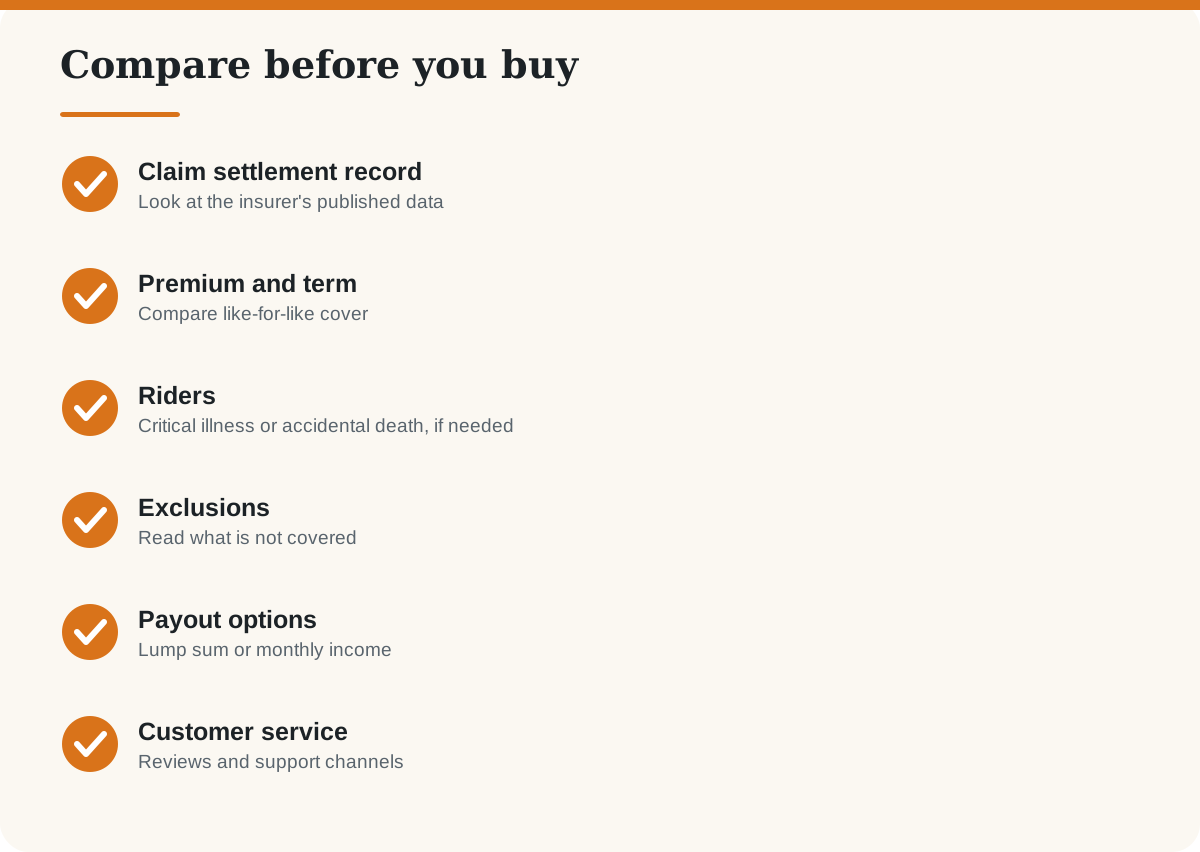
- Shortlist insurers. Confirm they are registered with IRDAI and compare their published claim data and service reviews.
- Get quotes for the same cover and term so the comparison is fair.
- Fill the application honestly. Declare smoking, alcohol, existing conditions, family history, income and other policies.
- Complete any medical checks or verification the insurer asks for.
- Read the policy document once it arrives, including the free-look period terms, and keep a digital copy.
- Set up automatic premium payment or reminders so the policy never lapses.
What mistakes do first-time buyers make?
- Hiding information about smoking, health or other policies, which can lead to a rejected claim.
- Mixing insurance with investment and ending up under-insured.
- Waiting until later, when premiums are higher or health conditions arise.
- Not telling the family where the policy is and who the nominee is.
- Letting the policy lapse by missing premium dates.
- Choosing only on price without checking the insurer’s claim record and the policy exclusions.
What should your family know?
A policy only helps if your family can claim it. Tell your nominee that the policy exists, which insurer it is with and where the documents are kept. Keep the policy number, insurer’s contact details and your login information in a place your family can reach. Update nominee details after marriage, divorce or the birth of a child.
Term cover works best alongside other basics: a stable emergency fund, health insurance, a clear budget and regular investing through a SIP. For a regulated view of insurance, see the IRDAI website.
Frequently asked questions
What is term insurance?
A life insurance policy that pays a sum assured to your nominee if you die within the policy term. A basic plan has no maturity benefit.
When should I buy term insurance?
Generally as early as possible once someone depends on your income, because premiums are usually lower when you are younger and healthier.
How much term cover do I need?
It depends on your loans, family expenses, goals and existing savings. A licensed adviser can help you estimate a figure.
Can a claim be rejected?
Yes, for reasons such as non-disclosure of material facts, a lapsed policy or exclusions in the terms. Disclose honestly and read the policy document.
Is term insurance an investment?
No. It is protection for your dependants. Combining insurance and investment in one product often means lower cover for the money.
Can I buy term insurance online?
Yes, many insurers sell term plans online. Compare plans, check the insurer is registered with IRDAI and keep digital copies of the policy.
Sources
Last checked: October 2026. Educational content, not insurance or financial advice. Policy terms, premiums and tax treatment vary; read the policy document and consult a licensed adviser. Figures in the cover example are assumed for illustration.